


Men's mental health: why more and more men are seeking help
Movember: a new vision of men's mental health
Every November, moustaches sprout everywhere — and it's not just a matter of style. Movember, born in 2003 in Australia, has become a national charity that focuses on prevention and promoting men's mental health. The movement encourages men to take action for their health by addressing prostate cancer, testicular cancer, suicide prevention among men, and, of course, mental health.
Movember also redefines what it means to be strong. For a long time, masculinity was associated with the idea of holding on silently. Today it takes another form: the courage to ask for help, to listen to one's emotions, and to take care of oneself in order to be fully present for those you love.
Beyond the symbol, Movember creates real, authentic conversations among men — conversations that break taboos and help men feel less alone in facing their challenges.
Mindsets are changing. Mental health is now part of overall health and well‑being, on par with physical health, nutrition or sleep. We increasingly understand that body and mind move together, that anxiety, irritability and anger are not to be swept under the rug, and that taking care of your mind is taking care of your whole life.
What motivates men to seek help?
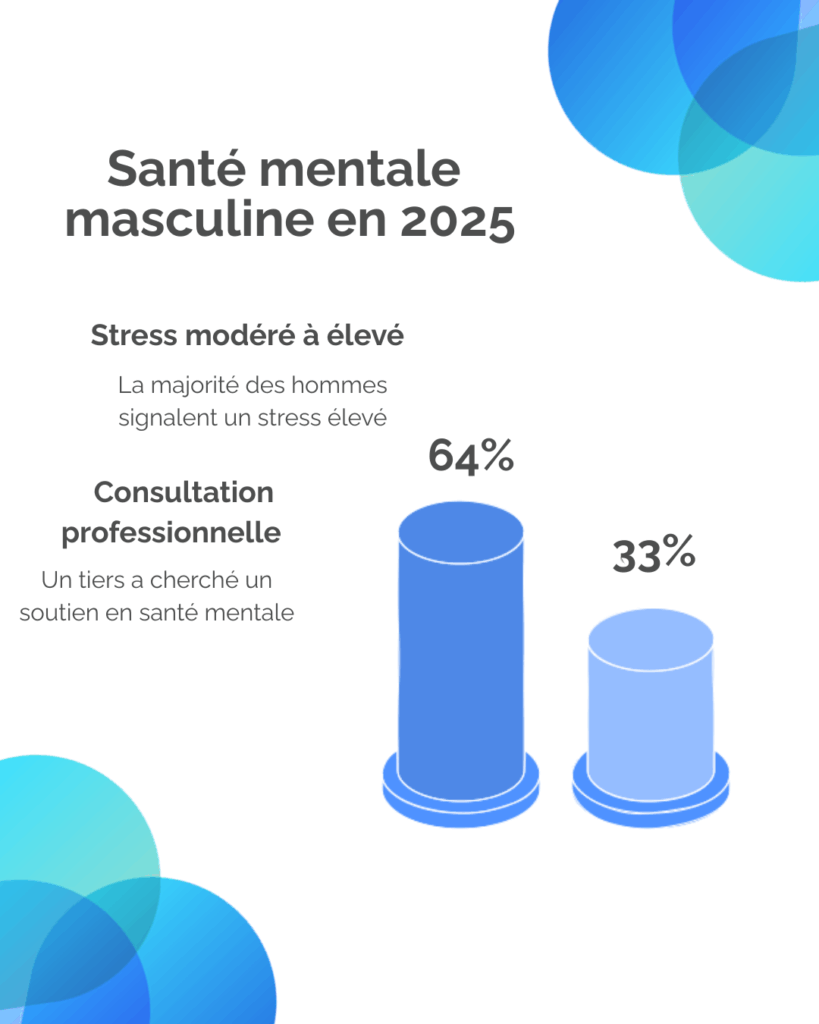
It is estimated that about one million men suffer from depression each year in Canada, a clear sign that mental health issues are real. At the same time, nearly 64% of men aged 15 and over report experiencing moderate to high stress, and one third have already sought professional support.
If men choose to see a health professional today, it's because they recognize the importance of being well in order to move forward. Their motivations are human, sincere and driven by a real desire to improve their condition.
By taking care of themselves, men also take care of those they love. It allows them to move forward, stay engaged and fully support their family and friends — an essential aspect of men's well‑being.
The desire to perform… without burning out
Performance no longer has the same meaning as before. More and more men understand that focus, decision‑making, creativity and motivation rely on a balanced mind.
Choosing to seek help improves your mental health, but also your relationships, your work and your energy, which can be affected by mental health problems. It's an act of courage, a way for men to live more fully and in better health.
The evolution of masculinity
The "I can manage on my own" stance is slowly giving way to a more humane masculinity: communicating, naming what you're experiencing, respecting your limits, listening to your needs. A different kind of strength, but just as real.
Support from those around you
Sometimes it's a caring presence — a friend, a partner, a colleague — that creates the space needed to take the first step. A simple question, a look, a "how are you, really?" can change everything. This support helps men overcome what prevents them from seeking help.
Inspiring role models
Athletes, artists, entrepreneurs… Many people today speak openly about therapy, men's depression, anxiety or mental health disorders. These influential voices normalize the process and strengthen the promotion of mental health in society, normalizing the step and reminding us that you can be strong, ambitious, courageous… and seek help.
The diversity of available approaches
There is no longer just one way to get help. Psychotherapy, social work, psychosocial intervention, neuropsychology, occupational therapy, art therapy… This diversity allows each man to find an approach adapted to men and their realities, according to gender, age, or the signs and symptoms they experience — for personal challenges or mental health problems, support is crucial.
Acting before the crisis
More and more men no longer want to wait until they hit a wall. They seek help to prevent, not to repair; to better know themselves, not to extinguish themselves; to remain themselves, not to hold on by sheer force.
The support pathways men prefer in mental health
When a man decides to seek help, he's not looking for the same thing as everyone else. Some want concrete tools. Others want to understand what is happening inside them. Others still need a place to put down what cannot be put into words.
What stands out, however, is this: men prefer approaches that respect their pace and way of being, that allow them to move forward without pressure and to feel active in their well‑being.
Here are the avenues that come up most often:
Practical, solution‑oriented approaches
(Social work • Occupational therapy • Psychosocial intervention)
Many men appreciate approaches that help them better organize their daily life, lighten their mental load, clarify what overwhelms them or regain a certain sense of control.
Social workers, psychosocial workers and occupational therapists offer precisely this concrete, structuring presence, focused on accessible and realistic solutions. These approaches allow you to leave with simple strategies… and a little more breathing room.
Spaces to understand what's going on inside
(Psychotherapy • Psychoeducation)
Other men seek a space to reflect: on their emotions, their reactions, what repeats itself in their personal or professional life. Psychotherapists and psychoeducators create this environment of exploration: a place where one can understand one's patterns, impulses, limits… without judgment, with kindness. These approaches give meaning — and sometimes, a lot of gentleness.
Methods to express in other ways what is difficult to say
(Art therapy)
For some men, expressing themselves verbally isn't natural. Art therapy offers another path: a space where you can shape what you can't say, let emerge what is playing out inside you, without having to explain everything. It's an approach that opens doors differently, often with surprise and delicacy.
Assessments to better understand oneself
Sometimes a man senses that something is wrong — cognitive fatigue, impulsivity, difficulty concentrating, memory loss, mental overload… Neuropsychological assessments make it possible to better understand what is happening in the brain and how stress, anxiety or even cognitive load affect daily life. It's a bit like turning the light back on in a dark room.
Relationship‑focused support
(Sexology • Social work • Psychotherapy)
Relationships occupy a large place in men's lives. Many seek help to improve communication, emotional closeness, trust or intimacy — in the couple, the family, or even at work.
Sexologists, social workers and psychotherapists offer tools to better understand yourself… and to better understand the other person. These approaches transform relationships, sometimes subtly, sometimes profoundly.
How to choose the right support
Each man arrives with his history, his strengths, his challenges, his way of moving forward. That's why there isn't a single right way to take care of your mental health — only the one that truly resonates for you.
Some feel better with a concrete, solution‑oriented approach. Others prefer a more introspective space. Others progress better by creating, or by understanding more precisely how their brain reacts to stress and everyday challenges. The essential thing is to listen to what makes you feel good.
And because it's not always obvious to know where to start or which professional to turn to, Familio's clinical coordinators are there to help you take the first step. They take the time to understand your situation, your goals and your pace. Their role: to guide you toward the support that really suits you, without pressure, with kindness.
Familio services: an interdisciplinary team for men's mental health accessible throughout Quebec
For men who wish to consult a professional,Familio offers a full range of mental health services in its clinics in Boucherville, Rosemont and Chicoutimi, as well as online consultations for those living elsewhere in Quebec.
Our interdisciplinary team includes, among others:
- some social workers,
- some psychotherapists,
- some psychoeducators,
- some sexologists,
- some occupational therapists,
- some neuropsychologists,
- some psychosocial workers,
- some art therapists
- some psychologists.
Each approach has its own character and pace, but all share the same intention: to offer men a space where they can breathe, understand, move forward and feel truly supported. A human, professional and accessible support — in Boucherville, Rosemont, Chicoutimi or remotely, anywhere in Quebec.
By
Kym Lefebvre Gamache
Sources
Canadian Men’s Health Foundation. 2025 Study: Stress, Depression & Canadian Men.
https://menshealthfoundation.ca/press/2025-study-stress-depression-canadian-men/
Don’t Change Much. Canadian Men’s Mental Health Research 2025.
https://dontchangemuch.ca/mental-health/canadian-mens-mental-health-research-2025/
Benefits and Pensions Monitor. Two Out of Three Men Never Ask for Mental Health Help.
https://www.benefitsandpensionsmonitor.com/news/industry-news/two-out-of-three-men-never-ask-for-mental-health-help/392057
Fondation Santé des Hommes. Research 2025 – Mental health of Canadian men. https://fondationsantedeshommes.ca/recherche/recherche-2025-sante-mentale-hommes-canadiens/
Available resources and support
Des hommes qui changent
https://deshommes.ca/
À coeur d’homme
https://www.acoeurdhomme.com/
Phone: 418 660-7799, toll-free 1-877-660-7799
Hommes Québec
https://hommesquebec.ca/
Phone: 1-877-908-4545
Réseau Maisons Oxygène
https://maisonsoxygene.ca/
Phone: 438-504-4000
Regroupe pour la Valorisation de la Paternité
https://www.rvpaternite.org/
Regroupement des Organismes pour Hommes de l’Île de Montréal (ROHIM)
https://www.rohim.net/
Phone: 438-397-0698
Centre de ressources pour hommes de Montréal
https://www.crhmontreal.ca/
Phone: 514-355-8300 / +1 833-673-2746 (OSE-CRHM)
Related articles

Preventing mental fatigue: take care of your health to avoid burnout
Between personal responsibilities, the workplace, unexpected events, and an often demanding pace of life, our brains are now under constant strain. Notifications, screens, multitasking, and the need for instant gratification sometimes leave little room to truly unwind or recharge. This reality is becoming increasingly prevalent. In 2023, more than 4.1 million Canadian workers reported experiencing high levels of work-related stress and daily overload.

Understanding grief: stages, emotions and the grieving process | Familio
When pain returns as time passes, it’s normal to wonder why. We hear about the stages of grief, as if simply going through them one by one would make things better. As if there were a "right way" to grieve. Yet grief does not follow a straight line. It can come back in waves, take different forms, and be experienced very differently from one person to another. Understanding what is happening can help put words to what we feel, recognize returning emotions, and know when to seek support.
Caregivers: the often invisible pillars of our society
Supporting a loved one experiencing loss of autonomy, caring for an ill spouse, or being present for a child with particular challenges — for many caregivers, these situations are simply part of daily life. Learn about caregivers, the impact on their mental health, and how to better support them.