

Trans journey and gender identity in Quebec: asserting oneself, despite doubts
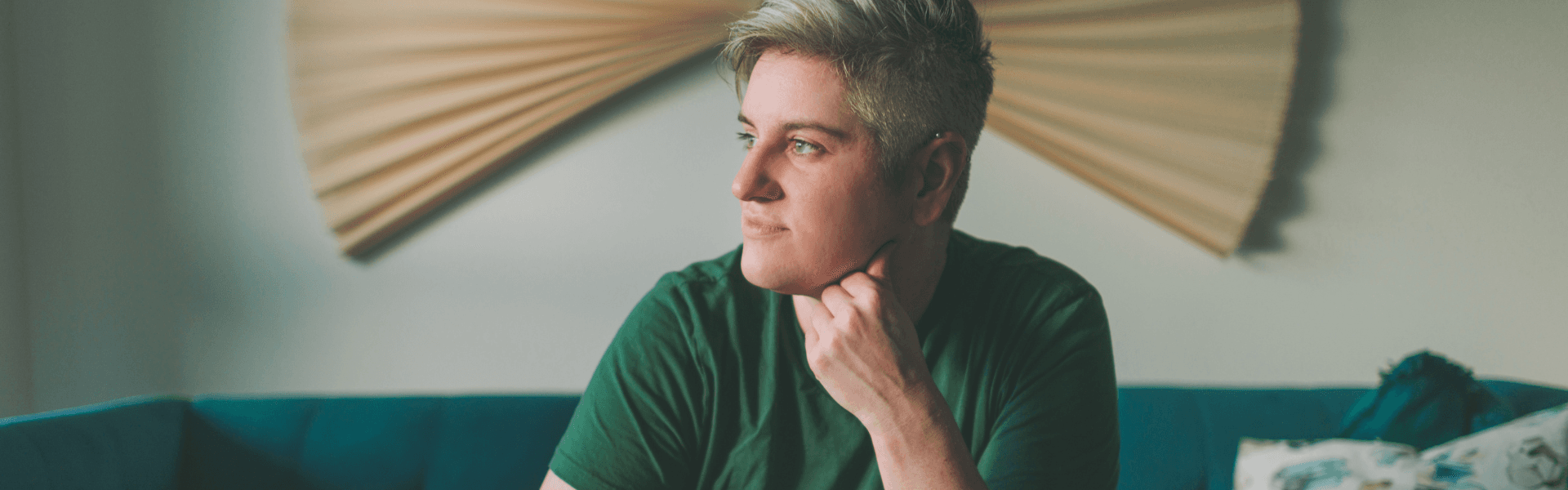
After having given the floor to the mother of a non-binary child to discuss gender dysphoria in 2023, then to a young adult who shared their identity questioning during puberty in 2024, we continue our series of testimonies as part of 2ELGBTQI+ Pride Month by highlighting Astrid's inspiring journey — a transgender woman who managed to carve out a place in two still very male-dominated fields: management and emergency services.
This profile is also an opportunity to remind that services like Familio are there to compassionately support those who question their gender identity or sexual orientation, to support families and to promote inclusive and respectful living environments.
A person above all: meeting with Astrid
Astrid is a 39-year-old trans woman, a parent of two children. "Not dad nor mom," she specifies. "I don't want to say mom because I feel it takes away a part of the mother's, the woman's biological role." Between her family, her job as a manager, her work as a firefighter, and the trainings that come with it, Astrid lives her life at 100 miles an hour.
Her history related to transsexuality goes back to her earliest childhood. She recounts, half jokingly, that her mother only learned her sex very late during the pregnancy because it was not visible on ultrasounds. But she had prayed every day for a boy.
"I was aware of it since I was very little. I was raised by my mother and my grandmother and I remember asking my grandmother why I had a penis, when I was going to have breasts. And at some point, from being 'nagged', 'convinced', 'explained' [...] I ended up stopping talking about it. But I don't blame anyone, not my mother or my grandmother; back then there were no tools to understand young people who felt different like me in their bodies."
From adolescence to adulthood
"It was around 14 that I talked about it again with my mother. I felt like something was not right, I was thin, too thin. I felt bad about how I was. We met a doctor who suggested seeing an endocrinologist to take hormones so that I could have a shape. I was happy, because I had heard about hormone therapy: I wanted to talk to the endocrinologist to take puberty blockers and female hormones."
Astrid hoped to be able to initiate a transition in the direction she wanted and to receive support.
"But I couldn't speak to him alone. So he prescribed me male hormones. After a week of taking hormones, I thought I was going crazy. I told my mother that everything was fine, but I simply stopped talking about my dysphoria. And I began to withdraw, to want to hide, to want to hide the woman in me, to use cannabis, I wanted to find a way to escape into another universe."
"At 18 I decided to leave the family home to go with my best friend to Montreal. I decided it was my new chance. And I met a doctor who convinced me not to transition. He told me I was going to ruin my life, end up prostituted in the Village, that I would never find a good job… It was my second failure in the project. [...] So I told myself he might be right. I was 19 by then, I told myself work, get yourself a girlfriend, have a child. Do the stereotype of the man. Maybe that way you'll become a man and feel like a man.
So I met the mother of my children, I had my daughter a few months later. I was very determined to get this idea out of my head. When I'm determined, I do it. We went to live for a while at my mother's, I obtained my high school diploma, I found myself a good job, I bought us a house." But despite all these efforts to conform to a masculine image, the malaise persisted, and the model of a "standardized" life was no longer enough for Astrid.
"I wasn't really happy. I plunged myself into work to drown my pain. And it was at 27 that I had enough. I had reached the stage where it was either change or suicide."
A medical and social transition lived with determination
"Things were getting worse and worse in my relationship. My partner wanted a second child, I didn't. I felt like an impostor in that project. Then finally the child was conceived and I fell into a deep depression. At that time, I had never talked about it to anyone, not even to my best friend, who was, by the way, mad at me for a long time."
"On Valentine's Day 2013, my partner told me she was pregnant. And I, I told her that I wanted to do my transition. That was my coming-out. We cried, we were angry, ecstatic… the whole range of emotions went through. I felt egocentric in what I was doing, a lot. But I felt that I had no choice. I didn't really want to die. I didn't want to make my daughter suffer by taking my own life."
"My partner at the time was very supportive. I began transition procedures in May 2013, and my son was born in October." "When I started hormone therapy, after two or three months, I felt the beneficial changes. I felt I was going in the right direction, that I was validated in my gender transition. I self-validated. Emotionally, physically, I finally felt good with myself. The feeling of no longer feeling testosterone in my veins. It was like a poison running through my body. Thanks to the medication, I finally stopped feeling its harmful effects. Every fiber of your body vibrates the way it should vibrate by default. My daughter was 8 years old at that time. And I was ready to talk to her about it."
"At first, my daughter's fear was that I would disappear, like a rabbit in a hat. But I explained to her that I was going to stay, and it passed very quickly. It was the first time she feminized her language in relation to me. It took two days. She was happy, she only saw the positive; I was happier, everything was more beautiful and she preferred it that way. She wanted everything to happen quickly, that I have my surgery now!"
"And indeed, the most liberating moment truly was the operation. When I woke up after the procedure, the smile on my face… the nurses didn't understand, they asked me if I was okay and told me that I was the first person they'd seen smile like that after surgery."
"The hardest moment was the temporary rejection by my mother and my grandmother. In the house I had built, my grandmother lived below and my mother lived nearby. My mother would come to pick up my daughter and ignored me, wouldn't speak to me. My grandmother no longer wanted to speak to me, didn't want me to accompany her to do her shopping. We were not to be seen together. I was the shame of the family."
Today, their relationships have improved somewhat, but not 100%. "For my mother it took one or two years. She cut ties because she really didn't feel well. She even fell into a depression because of it. Afterwards she decided to take a trip to the Netherlands and met a Québécoise. And she opened up to that woman. And it was that woman who helped her understand that what I was going through was extraordinary. She came back and she took the first steps. My grandmother, that took a very long time. It is not yet repaired." And alongside her personal transition, Astrid also had to learn to assert herself in her workplaces, both marked by a strong masculine culture.
Asserting her identity in the workplace
Since she was very young, Astrid dreamed of driving large vehicles. "It was a little boy's dream, I wanted to drive buses, trucks. That was my fantasy." A dream she realized very early, in a predominantly male work environment — where she also began her transition.
"I came out in that environment, and I would say it went well 92%." For Astrid, this success is not a coincidence. She prepared herself, with intention and strategy. "I chose five influential colleagues, respected people, to be somewhat my ambassadors. I spoke to them first, I asked them to help me open the discussion."
She firmly believes that openness attracts openness. "I talked about it without taboo. I even made jokes, I was frank. It defused many awkward situations. Everyone was open, helpful, loving... I have a lot of respect for all those who helped and supported me."
A few clashes occurred, but she addressed them calmly: "I wasn't angry. I kept talking to them. I wanted them to see that I remained the same person. Ignorance breeds fear. But when you understand, you move toward acceptance."
It was after her transition that she attained a management position. "It allowed me to manage with more sensitivity. My experience made me more attentive, more human. I understand what it's like to be afraid to be yourself."
In her second professional environment — the fire services — Astrid did not initially talk about her identity. "It had become so normal for me to be transgender and to live my gender transition. So I didn't really talk about it at the start when I arrived. But one day, colleagues saw a trans flag on my social media. And then two people came to ask me the question directly: 'Are you trans?' I found that so honest. I told them yes, and that they could ask any questions they wanted."
Even in this universe often perceived as macho, she was able to take her place and be herself. "I never had anyone disrespect me. Never. I am able to make jokes about it, and I am respected."
By fully embracing her identity, Astrid was able to build a solid career, both as a manager and as a firefighter, in two fields where female — and trans — role models are still too rare today. Her trajectory proves that you can be yourself, and go far — even where you are least expected.
Trans identity in today's society
Astrid keeps a clear-eyed view on the social evolution of recent years. "We experienced a certain golden age for trans people, but of short duration — let's say from 2014 to the pandemic. There were concrete advances, rights were better recognized, there was more discussion, public figures like Michel Blanc spoke out, the government too." Then COVID-19 arrived, and it seems to have darkened everything.
Since then, Astrid perceives a shift: "Figures like Donald Trump, Andrew Tate, Jordan Peterson have fueled fears, spread false ideas." She also acknowledges that with the rapid openness of recent years, certain lines may have become blurred, that highly publicized cases were misunderstood. "We went from openness to a certain mistrust. There were excesses, people who identified with all sorts of things. And now, it's as if the pendulum is swinging the other way. But ultimately, I think the LGBTQ+ issue will have to be debated again, that we will have to keep fighting. We will have to continue defending our rights."
Her message to young trans people is full of tenderness and lucidity: "It's normal to ask yourself questions. It's normal not to feel good in your body. If you think you are trans, the first step is to talk about it with someone close." She continues: "Create a network of trans people around you and get informed. Before making decisions that will impact your body, consult, see a psychologist. And surround yourself with friends who will support you."
Astrid emphasizes the importance of freeing yourself from others' gazes: "Life deserves to be lived, and lived as you really are. The most beautiful thing you can do is free yourself from the prison of the person you are not." And of taking back control of your own trajectory: "There is no one who can define you except yourself. The only way your story will end badly is if you are not yourself. Be the actor, the director, the screenwriter of your own life... that way, no one will be able to tell you what to do. And then you will be the viewer of the film you have created."
Caring, together
Astrid's journey shows that it is possible to accept yourself, to get back up and to find your place — even when the path is far from easy. It's an important reminder: everyone deserves to be listened to, respected and supported.
At Familio, we are here to support individuals and families at every stage of life. Whether it's to talk about gender identity, sexual orientation or mental health, our professionals offer a caring, non-judgmental space.
Because no one should have to make this journey alone.
This testimony is based on an interview conducted in June 2025 with Astrid, a transgender woman residing in Quebec.
Resources related to trans identity
A comme Allié (2025)
https://acommealliees.ca/
An awareness project aimed at better equipping young people and adults to become allies of LGBTQ+ people.
ASTT(e)Q (2025)
https://cactusmontreal.org/soutien-aux-personnes-trans/
Offers support to trans and non-binary people, particularly the most marginalized, through mutual aid and access to medical, social and legal resources.
Aide aux Trans du Québec (ATQ) (2025)
https://atq1980.org/
Support for any trans person or person questioning, as well as their loved ones, at all stages of their journey.
AlterHéros (2025)
https://alterheros.com/
Community platform for information, awareness and mutual aid for young people experiencing questions related to sexual orientation, gender identity and expression.
Divergenres (2025)
https://divergenres.org/
Organization defending the rights of trans, non-binary people and gender plurality. Workshops, support and accompaniment.
Diversité 02 (2025)
https://diversite02.ca/
Support organization for LGBTQ+ people and their loved ones in the Saguenay–Lac-Saint-Jean region.
En mode ado (2025)
https://enmodeado.ca/
Information and support space for Quebec adolescents, including content related to gender identity and sexual orientation.
Familles LGBT (2025)
https://familleslgbt.org/
Resources for LGBTQ+ families or those becoming families, including parents, children and loved ones.
GRIS Québec (2025)
https://grisquebec.org/
Organization that demystifies sexual orientations and gender identities in school settings through testimonies and workshops.
Interligne (2025)
https://interligne.co/
24/7 help and listening service for people concerned with sexual and gender diversity, as well as their loved ones.
Jeunesse, j’écoute – Espace LGBTQ+ (2025)
https://jeunessejecoute.ca/information/jeunes-2slgbtq-et-allies-cest-votre-espace/
Confidential listening and information platform for LGBTQ+ youth, free of charge.
Le JAG (2025)
https://lejag.org/
LGBTQ+ community organization for youth and adults in Montérégie. Workshops, discussion groups, awareness-raising.
PFlag Canada (EN) (2025)
https://pflagcanada.ca/
Support network for parents, families and friends of LGBTQ+ people across Canada.
TransEstrie (2025)
https://transestrie.org/fr/ressources/
Various resources, guides, support groups and accompaniment for trans people and their loved ones in the Estrie region.
Transitionner.info (2025)
https://transitionner.info/
Informative platform developed in Quebec about transition journeys, including medical, social and legal procedures.
Youth Line (EN) (2025)
https://www.youthline.ca/
Listening and support service by and for LGBTQ+ youth in Ontario. Phone line, chat and local resources.
By
Kym Lefebvre Gamache
Related articles
Preventing mental fatigue: take care of your health to avoid burnout
Between personal responsibilities, the workplace, unexpected events, and an often demanding pace of life, our brains are now under constant strain. Notifications, screens, multitasking, and the need for instant gratification sometimes leave little room to truly unwind or recharge. This reality is becoming increasingly prevalent. In 2023, more than 4.1 million Canadian workers reported experiencing high levels of work-related stress and daily overload.

Understanding grief: stages, emotions and the grieving process | Familio
When pain returns as time passes, it’s normal to wonder why. We hear about the stages of grief, as if simply going through them one by one would make things better. As if there were a "right way" to grieve. Yet grief does not follow a straight line. It can come back in waves, take different forms, and be experienced very differently from one person to another. Understanding what is happening can help put words to what we feel, recognize returning emotions, and know when to seek support.
Caregivers: the often invisible pillars of our society
Supporting a loved one experiencing loss of autonomy, caring for an ill spouse, or being present for a child with particular challenges — for many caregivers, these situations are simply part of daily life. Learn about caregivers, the impact on their mental health, and how to better support them.