


Attention Deficit Disorder (ADHD) in adults
You have just realized that, once again, you forgot to reply to that important email you received days ago. You feel disappointment rising, anger welling up inside you. Each time these lapses occur, they add another layer of frustration and doubt, fuelling the sense of constantly struggling against a mind that seems to have its own agenda.
More than simple forgetfulness, these incidents can sometimes have a much greater impact on our daily lives and may be indicators of a condition more commonly associated with childhood: Attention Deficit Disorder, with or without Hyperactivity (ADHD) in adults.
Recognizing ADHD symptoms in adults
ADHD is a neurodevelopmental disorder characterized by persistent difficulties with attention, regulation of impulsivity, and hyperactivity. Attention Deficit Hyperactivity Disorder (ADHD), often associated with childhood, also affects adults. Diagnosing ADHD in adults is not always simple, as symptoms can manifest differently than those observed in children.
Symptoms of attention deficit disorder without hyperactivity – ADD in adults
- Distractibility: difficulty staying focused or maintaining attention on a task for long periods.
- Problems with attention and organization
- Difficulty managing time
- Tendency to lose items or forget appointments.
- Frequent procrastination or difficulty getting started on tasks.
- A feeling of mental disorganization or frequent confusion.
- Difficulty following instructions or finishing what one starts.
- Easily distracted by external stimuli.
- Impulsivity in decisions or verbal responses.
- Low self-esteem
- Does many things at the same time but does not finish them
- Tendency to experience anxiety related to the difficulties they must overcome
Symptoms of attention deficit hyperactivity disorder – ADHD in adults
In addition to the ADHD symptoms listed above, adults with ADHD may also show: Hyperactivity: constant restlessness, inability to sit still, need to move frequently.
Exacerbated impulsivity: hasty decision-making, difficulty waiting one’s turn, impulsive behaviour, frequent interruption of others during conversations.
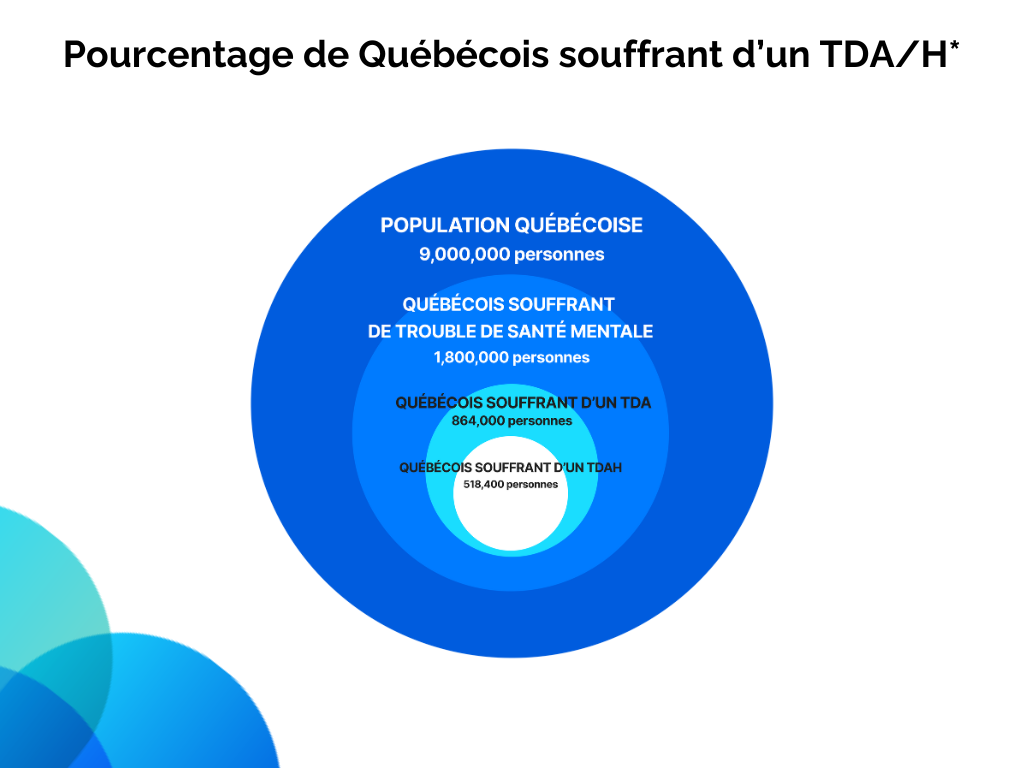
A disorder with multiple repercussions
Attention Deficit Disorder without Hyperactivity (ADHD) in adults has many repercussions in daily life. Indeed, adults with ADHD see numerous areas of their lives impacted by their condition. These challenges, often complex and varied, reflect the broad nature of this neurological condition and its profound impact on the lives of those affected.
It is important to note that many people with ADHD are undiagnosed but still experience associated problems and difficulties related to this mental health disorder.
Romantic relationship
ADHD can significantly affect couple dynamics, leading to misunderstandings and tensions. According to recent studies, people with ADHD would present a higher percentage of conflicts, dissatisfaction, and breakups than the general population on average (Wymbs et al., 2021).
Partners may feel neglected or overwhelmed by the impulsivity and frequent forgetfulness characteristic of this disorder. These behaviours can be wrongly interpreted as a lack of interest or consideration, thereby eroding trust and intimacy within the couple. In addition, managing daily tasks and responsibilities can become an area of conflict, as the person with ADHD may have difficulty completing them consistently.
It is therefore crucial for couples to recognize the impact of ADHD and to work together toward mutual understanding.
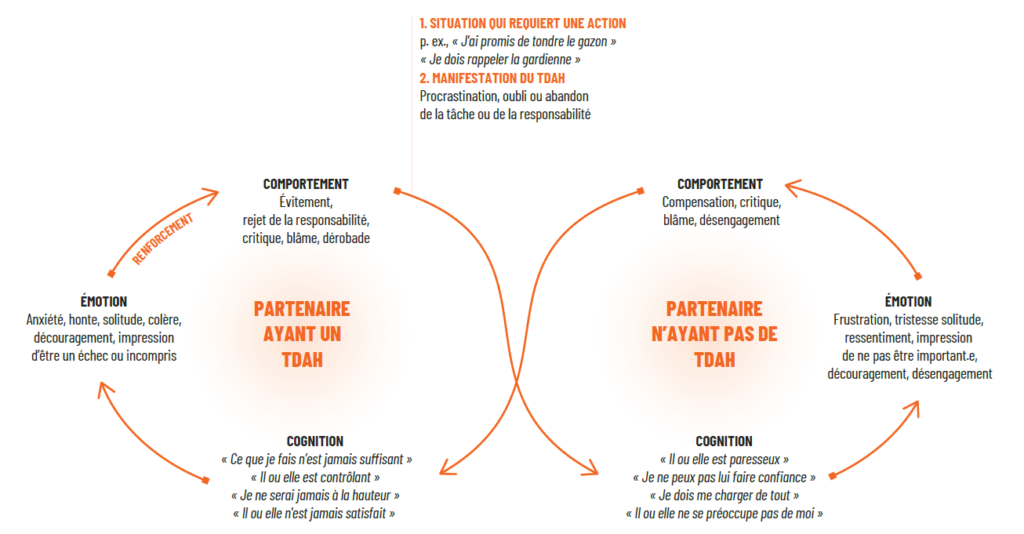
Reference: Order of Psychologists of Quebec. (n.d.). Manifestations of ADHD in the couple. Retrieved from https://www.ordrepsy.qc.ca/-/manifestations-tdah-couple
Interpersonal relationships and relational difficulties
ADHD does not only affect the couple relationship but also extends to interpersonal relationships as a whole, often creating invisible barriers between the person affected and those around them. Challenges in communication and inattention, a common characteristic of ADHD, can lead to misunderstandings and frustrations in various types of relationships, whether friendships, family, or professional.
Daily organization
Managing tasks and responsibilities can be difficult for people with ADHD, leading to significant challenges in adulthood. This can even deeply impact their quality of life and well-being. Difficulty maintaining attention, a tendency to procrastinate, and memory problems can seriously hinder personal and professional organization.
This often manifests as difficulties planning and prioritizing activities, meeting deadlines, and managing time effectively, leading to a constant feeling of being overwhelmed and stressed. In addition, routine tasks and long-term commitments can seem insurmountable, which can lead to avoidance and an accumulation of unresolved tasks.
Work performance
ADHD can considerably influence professional performance, introducing unique challenges in the workplace. People living with ADHD may experience difficulty concentrating on specific tasks and sustaining their focus. This can affect work, lead to errors and/or inconsistent productivity, which can be misinterpreted by employers and colleagues as a lack of motivation.
Moreover, time management and organization can also affect the ability to meet deadlines and handle workload. This can lead to repeated delays in project submissions and a sense of being overwhelmed, increasing stress and anxiety at work. In addition, difficulties managing emotions can make criticism or feedback harder to accept, thereby impeding professional and personal development.
Self-esteem and personal development
In summary, the various difficulties related to ADHD—whether concerning the couple relationship, social interactions, daily organization, or professional performance—intertwine and exert a considerable influence on self-esteem. Each aspect of these challenges can fuel a sense of insufficiency and inadequacy, contributing to a negative self-image. Repeated trials in intimate relationships, frequent misunderstandings with loved ones, obstacles to effective daily management, and pitfalls encountered in the professional environment are all factors that, combined, can deeply undermine confidence and one’s sense of self-worth.
This dynamic underscores how crucial it is to recognize ADHD not only as a set of symptoms to manage but also as a condition that has a profound impact on personal development and self-esteem.
Managing ADHD in adulthood
Addressing ADHD goes beyond simply managing symptoms; it also includes strengthening a constructive and resilient self-perception. The path to improved self-esteem involves a detailed recognition of the specific obstacles posed by ADHD and adopts a comprehensive strategy that highlights the individual’s unique qualities, stimulates personal development, and cultivates self-acceptance. This process not only promotes better management of ADHD-related challenges but also helps build a sense of worth and confidence in one’s own abilities, essential for navigating life’s complexities with assurance and positivity.
Cognitive-behavioural therapy (CBT)
Cognitive-behavioural therapy (CBT) represents an effective approach for people with ADHD, particularly in the context of developing self-esteem and managing daily challenges. This therapeutic method focuses on identifying negative thought patterns and behaviours that can exacerbate ADHD symptoms or hinder personal well-being. CBT encourages individuals to recognize defeatist or irrational automatic thoughts and to challenge them critically in order to replace them with more realistic and constructive perspectives.
A key aspect of cognitive-behavioural therapy in the context of ADHD is learning strategies to modify problematic behaviours. This can include time-management techniques, organization methods, and approaches to improve social and communication skills. By working on these aspects, CBT helps reduce the feeling of overwhelm and inefficiency that often accompanies ADHD, thereby promoting better self-esteem and a sense of personal accomplishment.
Lifestyle changes
Adopting a holistic approach to navigate challenges involves integrating key aspects such as diet, digestion, and stress management. A balanced diet, rich in essential nutrients, supports optimal brain function and can help regulate symptoms. At the same time, effective digestion, promoted by sufficient intake of fiber and probiotics, positively affects mood. In addition, stress management through practices like meditation or yoga helps maintain emotional and cognitive balance, which is highly beneficial.
Good emotional management and restorative sleep are also fundamental. Understanding and expressing emotions in a healthy way makes it easier to navigate social interactions and complex situations. Quality sleep is essential for mood regulation and sustained concentration, underscoring the importance of a regular sleep routine and an environment conducive to rest.
Finally, note that physical activity occupies a central place, releasing neurotransmitters such as dopamine and serotonin, which are essential for attention control and mood regulation. Integrating exercise into the daily routine can reduce anxiety and promote better sleep, thus playing a crucial role in improving quality of life.
Importance of social support and a suitable environment
Social support and a well-adapted environment play a leading role, whether the person is already diagnosed with ADHD or in the process of being diagnosed. The presence of a solid and understanding network can be a fundamental pillar in the process of recognizing and managing the disorder, also enabling relatives and caregivers to better understand the specific challenges encountered. This support can take many forms, ranging from empathetic listening to concrete assistance with daily tasks, as well as guidance toward appropriate professional resources.
A suitable environment, both personally and professionally, is essential to facilitate symptom management and encourage flourishing. Simple adjustments, such as an organized workspace or a structured framework for daily tasks, can have a significant impact on the ability to focus and remain productive.
Thus, the importance of caring social support and an adapted environment lies in their ability to offer a reassuring framework where the person feels understood and supported in managing ADHD. This creates a context conducive to exploring effective coping strategies and seeking creative solutions to overcome challenges, thereby paving the way for a more balanced and fulfilling life.
Medication
Medication for people with ADHD can be revealing. It provides marked relief of certain symptoms by improving, among other things, the ability to concentrate. Pharmacological treatments commonly prescribed, such as stimulants derived from methylphenidate and amphetamines, target increasing levels of neurotransmitters in the brain. This action contributes to better attention while decreasing impulsivity and hyperactivity, thus reducing difficulties related to these symptoms.
It is important to emphasize that the response to medication can vary considerably from one person to another, requiring careful follow-up by a health professional to personalize the treatment. Although medication can offer significant relief of certain symptoms, it is generally more effective when combined with other interventions, such as cognitive-behavioural therapy and lifestyle changes, in an integrated approach to managing ADHD.
In conclusion, faced with the challenges that ADHD can present, do not remain isolated. If you are experiencing difficulties that could be related to this disorder, it is strongly advised to consult a neuropsychologist or a psychologist accredited by the Order of Psychologists of Quebec. A professional diagnosis can open the way to a better understanding of your situation and to developing appropriate strategies to manage symptoms.
We invite you to visit one of Familio’s mental health and social services clinics, where a dedicated and caring team will support you at every step of your journey toward well-being. Together, let us explore the possible avenues for a more balanced and fulfilling life.
List of useful resources for adults living with ADHD
Associations and foundations
ADHD Mauricie and Centre-du-Québec
Network of PANDA Associations of Quebec
Book
De Coster, P. (2022). ADHD in adults. Learning to live peacefully with your attention disorder. Brussels: Madarga.
Zylowska, L. (2016). Mindfulness and attention disorders with or without hyperactivity in adults (T. Hergueta, Trans.). Paris: De Boeck Supérieur.
Moulton Sarkis, S. (2008). 10 solutions for attention deficit in adults. Saint-Constant: Broquet.
Ramsay, J. R., Rostain, A. L., with the collaboration of Lagacé-Leblanc, J. (2020). Living better with ADHD in adulthood: Practical guide to adapt in all circumstances. Québec, QC: Presses de l’Université du Québec.
Vincent, A. (2022). My Brain Still Needs Glasses. Montreal: Les Éditions de l’Homme.
Sources
American Psychiatric Association. (2013). Diagnostic and statistical manual of mental disorders (5th ed.).
Government of Quebec. (n.d.). About mental disorders. Ministry of Health and Social Services.
National Institute of Public Health of Quebec (INSPQ). (n.d.). Study. INSPQ.
La Presse (2024, January 25). Quebec surpasses 9 million inhabitants. La Presse.
Merck Sharp & Dohme Corp. (n.d.). MSD Manuals.
Order of Psychologists of Quebec. (n.d.). Manifestations of ADHD in the couple. Retrieved from https://www.ordrepsy.qc.ca/-/manifestations-tdah-couple
Wymbs, B. T., Canu, W. H., Sacchetti, G. M., & Ranson, L. M. (2021). Adult ADHD and romantic relationships: What we know and what we can do to help. Journal of Marital and Family Therapy, 3(47), 664-681.
Related articles

Clinical Supervision in Mental Health: Learning, Growing, and Sharing
Clinical supervision can support mental health professionals at various stages of their careers: during training, in the early years of practice, when entering a new field of expertise, or simply when they wish to continue developing their professional practice.

Are you wondering if it's ADHD? When to seek help and what a neuropsychological evaluation is for
Are you wondering if it's ADHD? A neuropsychological evaluation goes beyond a diagnosis and sheds light on how your cognitive functions work in everyday life.

Assessment of dyslexia and dysorthographia: how to recognize them and when to consult
Summer is drawing to a close and already you are thinking about the start of the school year. You recall last year's homework evenings: your child settling down, pencil in hand, trying, trying again. And yet the words get jumbled, reading drags on, writing wears him out. You watch him: a curious, lively child, capable of telling a thousand stories aloud. But when faced with a page, the effort takes over.