

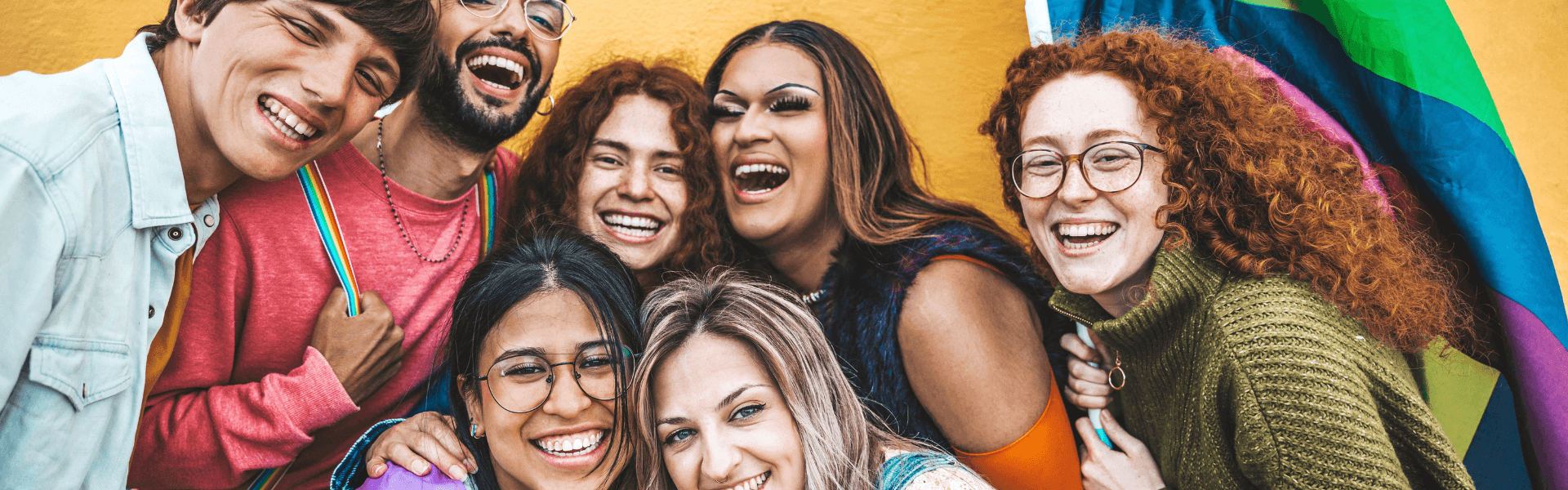
Adolescents, gender identity and sexual orientation: a current story
Adolescence is a period of transformation and experience. It’s the time when one explores their sexuality and discovers themselves; but this exploration can also lead to serious identity questions.
This is the case of Sage, a Quebec adolescent. From discovering their sexual orientation to questioning their identity: discover the ordinary story of a unique individual.
A short glossary of the spectra of sexual and gender diversity
Before continuing your reading, it is important to clearly grasp the vocabulary associated with the diversity of the 2ELGBTQI+ community. To appreciate the full richness of this community, it is essential to become familiar with the terms and concepts used to describe gender identities and sexual orientations. Each word has a specific meaning that contributes to better understanding and inclusion. You can refer to the glossary located at the end of this article at any time during your reading to clarify terms and deepen your knowledge of the spectra of sexual and gender diversity.
We also wish to specify that not all affirmation processes have to follow a predetermined procedure. Each path is unique and may or may not include a coming outin various living environments (e.g.: work, school, family, circle of friends), all depending on the degree of safety felt by the person concerned.
Discovering sexuality and first sexual experiences
Discovering one’s sexuality is a unique and often complex journey. For Sage, this journey began in childhood. “I started to have a more bisexual awakening when I was 9,” she shares. “There was a girl in my elementary school. Of course I was in love with her. I found her so beautiful. She had been dumped by her boyfriend because she had cut her hair. I wanted to be her best friend, hold her hand, I told her I thought she was beautiful.” This early awakening transformed into a clearer awareness during adolescence. “At 15 I became more aware that it was something very real.”
And adolescence also means first times. “With my friends in high school, we had experiences among ourselves. For them it was just fun to kiss, they found it funny, cool, it was a game… for me I really liked it. I liked kissing girls, not just as an experiment. I wanted to do it again at parties.” “Even on TV, I often had crushes on singers or actresses, I found them so beautiful!”
And Sage began to ask questions. Many questions. “I had a first sexual relationship with a woman at 14, but in my head I was still a virgin because there wasn’t ‘a penis’. I come from a very religious background, so of course I asked myself a lot of questions. I was also very ashamed because in my head, I thought that God did not approve.”
“Then, it became known at school. When you are bisexual people often think you’re a ‘slut’ because you ‘sleep with everyone’. I was harassed and sexualized by the other teenagers at my school. But I didn’t really talk about it.”
A first coming out, and further questioning
Coming out is often a pivotal moment in the lives of many people in the 2ELGBTQI+ community. “Honestly, I didn’t need to announce my sexual orientation to my friends. Everyone already knew!” he laughs. “But I was still the first to be considered ‘non-hetero’ in my group, and that even allowed others to ask me questions.”
“With my family too, it surprisingly went well. I just told my brothers and sisters that I had a girlfriend and that they would meet her eventually.” “One of my sisters told me that it didn’t fit with her values, but that she would still love me anyway.”
“My dad was a bit more difficult. We were talking about feminism, about how you have to be careful about how you dress because men in the street look at us… and I just said that I also find women attractive and that I don’t necessarily whistle after them in the street and that was my coming out. In the end he said he agreed with me and that if I respected women and didn’t whistle at them in the street, men should be able to do the same.” (Laughs.)
“My mother also took it well; she even reminded me of my ‘crush’ from when I was small. For another of my sisters, it went well because we were able to talk more and when she did her coming out afterward we were able to talk more about it and she could ask me questions and realize certain things and later do her coming out.”
“The hardest part was understanding and making others understand that it’s not because I’m young that it’s a phase. It’s not just an ‘experiment’ for the thrill of kissing girls or for discovering who I am. It’s not just a phase. Today, I know it—I’m pansexual. But at that time, I had a kind of disdain about myself. I thought I would never be able to accept it because of that, that I would never be able to accept myself.”
“Finally, I told myself that if there was a God, he would not want me to feel so bad as a person. Other questions related to religion then appeared... and in the end, I had to deconstruct certain teachings I had been taught when I was younger in order to be happy.”
Social pressure and expectations also played a role in his journey. “Regarding my orientation, it was as if within the LGBT community, I felt like an impostor when I had boyfriends. I wasn’t queer enough, legitimate for liking a boy. Whereas in the rest of society, when I had a girlfriend, it was a phase. It’s hard to be validated. If you’re bisexual or pansexual, you have to love women according to the community, while for the rest of society, when I love a woman, it’s a phase. It’s really not obvious to feel validated.”
An evolving sexual identity
Then the pandemic arrived. “At that time, I had a partner who talked to me a lot about their non-binary condition and about how they felt. I started to question people around me about why they felt like a man or a woman. And I realized that I didn’t have the same vision at all as them. In fact, I considered myself a woman because I had a vulva and society told me I was a woman. But deep down that wasn’t what I really felt. At that time, I considered myself non-binary.”
First, Sage had to go through a phase of accepting themself. “Since it was during the pandemic, I felt very alone in it. I was with my parents, I had a lot of difficulty communicating and I didn’t feel equipped enough to understand what I was. I was already aware of who I was, but I needed to find people like me to feel more at ease. I read many articles, but I needed to find people. I was very much alone without being able to talk about it.”
“It’s not new, for both orientation and gender identity. Of course in recent decades we have often been forced to hide, because it was heavily demonized. And for one of the first times now, we can live without hiding and speak openly. It’s not because it’s a trend, it’s rather that for a rare time in many decades, we can go out and no longer hide.”
“I think what was the most difficult was to deconstruct this patriarchal idea of a man and a woman, of marriage, children, family... love is not necessarily what’s in the books, what we are taught when we are small... we have the right to think and live love differently and that’s what’s beautiful.”
The freedom to be yourself... through pronouns
The second coming out of Sage, this time concerning their gender identity, was not as simple. “Do I need to change my first name so people understand that I don’t necessarily feel like a woman? Which pronoun should I use? Many people think it’s selfish to ask others to change pronouns. At first, I thought that since I was non-binary, I absolutely had to use the pronoun ‘iel,’ whereas I didn’t feel comfortable. Now I alternate the pronouns ‘he’ and ‘she.’”
“When I talked about it with my friends, it was a bit more difficult for them. Not to accept it, but to understand it. But when I asked them to change my pronouns, they accepted me immediately and supported me.” With one exception. “However, I lost a very close friend through this process. Her response was ‘I will never understand and I don’t think it’s true, but I can try to make an effort.’ She told me I was selfish and that I should think of others… whereas for me it’s a question of respect. So I chose to respect myself first and foremost.”
“Often people are afraid of our reaction, while we know very well that it requires an adjustment. Also sometimes we feel bad asking, talking about it. If you feel embarrassed to ask for a pronoun, you can use neutral terms instead, it’s a good alternative! There are plenty of alternatives to make people feel comfortable (e.g.: ‘you look really beautiful today’ vs ‘you look really handsome today’). People don’t always understand…”
“Today, I have understood that identity is something fluid. It’s not because I came out as bisexual and now I consider myself pansexual. We are not fixed in time, we are human, we evolve and understanding that is important because it’s perfectly normal to change and grow. But for now I am fine being a non-binary and pansexual person and surrounded by people who listen to me and understand me and try to understand for those who don’t know this.”
A situation in flux
“I think what can be hard for many young people is that often your circle of friends is already established and asking them to change habits regarding your pronouns can be difficult. And it’s not in all workplaces where you can be yourself. Same thing at school. It’s not everywhere that you have the possibility to communicate your identity. It’s not everywhere that it is accepted, or even tolerated.”
“I consider myself really lucky to live here and to live freely. But we must be aware that even here in Quebec, the most violent street manifestations are against community members and Asians. It’s difficult to walk in the street at night with your girlfriend. We get called dykes, we get asked if we want a penis… there is still a lot of improvement to be made, it’s not always safe to walk the streets when you are part of the community.”
“Personally, it would have helped me to have role models to refer to. Often the only visibility we have is negative – people say the community is exaggerating, that we ask for too much, that we’re too this, too that… it’s bad visibility. We are not listened to or seen for who we really are.”
“Almost every time we talk about a trans or non-binary person, it’s often linked to negative events (e.g.: a trans person was attacked, demonstrations, etc.) and that’s a shame. We could just talk about anything positive related to different people (business owner, achievements…). That would give young people role models to hold on to and lead them to no longer want to hide.”
A message of openness
Sage shares a message of openness and hope for society and for young people in the 2ELGBTQI+ community. When asked how society can better support young people in this community, he answers with disarming clarity and simplicity: “Listen and inform yourself first. It’s not because you are a heterosexual person that you cannot help the cause and the first thing to do is to educate yourself. To understand the terms, to understand the differences.”
“Because the more we understand, the more we respect. We sometimes hear that there are a lot of terms, but they are important because they refer to people who have been suffering for many years because they don’t fit into the heteronormative framework of society. Prejudices are often easy to undo when you take the time to educate yourself and understand the why behind things.”
For young people in the 2ELGBTQI+ community, Sage offers words of courage and perseverance. “Continue to be yourself, don’t be afraid. Even if sometimes we live through difficult situations because we are different, it’s worth remaining who we are. Don’t be afraid to ask to be respected, to be listened to as a person. It’s by continuing to come out that eventually we will no longer have to, because it will just be normal.”
These messages resonate as calls to action for each of us. By taking the time to listen, understand and respect differences, we can create a more inclusive and caring world for everyone.
If you need support
If you, your adolescent or a young person in your circle feel the need for support, know that Familio has experts in mental health and social services specialized in questions of gender identity who are ready to help you. Our qualified professionals are available to provide support adapted to parents and young people going through this period of exploring gender identity. Whether you have questions, concerns or are simply looking for practical advice, our team is here to offer you a safe and caring space.
We understand the challenges you may face and we are committed to supporting you throughout this journey, offering specialized resources and personalized support. Do not hesitate to contact us to obtain more information on how our experts can help you in this essential process for the well-being of your adolescent and your family.
Some resources for adolescents and young adults
Aide aux Trans du Québec
https://atq1980.org/
Alter Heros
https://alterheros.com/
En mode ado
https://enmodeado.ca/
Gris Québec
https://grisquebec.org/
Interligne
https://interligne.co/
Jeunesse J’écoute
https://jeunessejecoute.ca/information/jeunes-2slgbtq-et-allies-cest-votre-espace/
Le JAG: LGBT+ organization for youth and adults
https://lejag.org/
PFlag Canada (ENG)
https://pflagcanada.ca/
Youth Line (ENG)
https://www.youthline.ca/
Some resources for parents
A comme Allié
https://acommealliees.ca/
Famille LGBT
https://familleslgbt.org/
Gris Québec
https://grisquebec.org/
Interligne
https://interligne.co/
Le JAG: LGBT+ organization for youth and adults
https://lejag.org/
PFlag Canada (ENG)
https://pflagcanada.ca/
A short glossary of the spectra of sexual and gender diversity
2ELGBTQI+
Acronym designating Two-Spirit people, lesbians, gays, bisexuals, transgender people, queer, intersex, or those who use other terms related to sexual or gender diversity.
Agender
Gender identity of people who do not identify with any particular gender.
Ambisexuality
Ambisexuality is a sexual orientation. It refers to romantic or sexual attraction to both sexes or genders, often equally or similarly. This differs from gender identity, which concerns the personal perception and experience of one’s own gender.
Aromantic
Aromanticism is characterized by the absence of romantic attraction. Aromantic people do not feel romantic feelings, regardless of their gender or sexual orientation.
Asexual
Asexuality designates the sexual orientation of a person (asexual) who does not feel or feels very little sexual attraction to others, regardless of their gender identity.
Bi-curious
Bi-curiosity refers to a person with a defined sexual orientation, generally heterosexual or homosexual, who shows sexual curiosity for individuals to whom they are not usually attracted. Unlike bisexuality, bi-curious people choose not to identify as bisexual.
Bisexual
A person who is attracted to two or more genders without a particular preference.
Two-Spirit
The term two-spirit is the translation of the Anishinaabemowin term “niizh manidoowag,” which designates people who identify as possessing simultaneously a masculine spirit and a feminine spirit.
Cisgender
Term that designates people whose gender corresponds to the sex assigned at birth.
Demiromantic, Demisexual
A sexual orientation that is part of the asexuality spectrum. Term designating people whose sexual desire emerges gradually within an intimate and significant emotional relationship. Demisexual people do not feel sexual attraction toward someone until they have developed a strong emotional bond with that person.
Gender dysphoria
As defined in the Merck Manual:Discomfort or distress related to an incongruence between an individual’s gender identity and the sex assigned at birth, generally felt among young people.
Gender expression
Gender expression refers to the concrete way in which a person externally expresses their gender identity, regardless of their biological sex assigned at birth. This can be expressed through various elements such as clothing, hairstyle, makeup, body language and voice, and also includes the choice of a name and pronouns to refer to oneself.
Gender fluid
Gender fluidity refers to the experience of a person whose sense of gender varies or evolves over time. This means that the person may feel their gender as fluctuating rather than anchored in a fixed gender identity.
Heterosexuality
Heterosexuality designates the sexual orientation of people who are primarily or exclusively attracted to a person of the opposite gender, whether emotionally, romantically and/or sexually.
Heteronormativity
Dominant perception according to which heterosexuality would be the only “normal” and “natural” sexual orientation. This implicit social norm contributes to the invisibilization of homosexual people and their reality, whether consciously or not.
Homosexuality
Homosexuality designates the sexual orientation of people who are primarily or exclusively attracted to a person of the same sex, whether emotionally, romantically and/or sexually. This includes women attracted to other women, as well as men attracted to other men. Homosexuality is part of the diversity of sexual orientations and gender identities.
Gender identity
Gender identity is the personal and intimate perception a person has of their own gender, whether they feel like a man, a woman or other, regardless of their sexual orientation.
Sexual identity
The term “sexual identity” was formerly used in French to refer to gender identity and is no longer really used. Today, sexual identity mainly refers to the identity aspect of sexual orientation.
Iel
The pronoun “iel” is a neutral pronoun in French used to refer to a person without specifying their gender, whether they are a man, a woman or other. It is used by non-binary people or by those who prefer not to indicate their gender.
Intersex
The term “intersex” refers to a person born with physical sexual characteristics (chromosomes, gonads, hormones, genitalia) that do not strictly match typical definitions of male or female. Intersex people may present a combination of these characteristics, making their biological classification more complex.
Misgender
To misgender consists of using an incorrect pronoun or gender when addressing a person or speaking about them. In Canada, using an incorrect pronoun or gender can be considered a form of discrimination or a rights violation, as it denies and disrespects a person’s gender identity, thereby compromising their dignity and well-being.
Non-binary
Non-binarity is a gender identity that is not limited to the two traditional sexes, male and female. A non-binary person does not recognize themselves exclusively as a man or a woman and may identify outside or between these gender categories.
Sexual orientation
Sexual orientation is defined by the enduring attraction a person feels toward potential romantic or sexual partners.
Pansexual
The term “pansexual” designates a person who feels romantic or sexual attraction for others, regardless of their gender or sex. Pansexual people can be attracted to individuals of all genders, including men, women and non-binary people.
Pangender
A pangender person identifies with all genders simultaneously or at different times. These individuals may feel a connection with a multitude of genders, going beyond the traditional categories of male and female, often including non-binary genders.
Polyamorous
The term “polyamorous” designates a person who is open to having romantic relationships with multiple partners at the same time, with the consent and knowledge of all people involved.
Queer
The term “queer,” originating from English, initially had a negative connotation, meaning “strange,” “atypical,” “misfit.” Historically, it was used to designate members of sexual and gender minorities, those whose sexual orientation or gender identity differed from heterosexuality or cisidentity.
Today, the 2ELGBTQI+ community has reclaimed the term “queer” to describe people whose sexual orientation or gender identity does not conform to heterosexual or cisgender norms. It encompasses a wide variety of identities and sexual and gender behaviors, offering an alternative to traditional categories. However, it is important to note that the term “queer” should only be used by members of the LGBTQ+ community and cannot be appropriated by cisgender and heterosexual people. Let us recall that respectful use of language is essential to honor the experiences and identities of the people concerned.
Transgender
Transgender, or trans, people are individuals whose gender expression and/or gender identity differs from traditional expectations based on the sex assigned at birth. A person whose gender identity does not conform to “traditional” expectations may face these challenges even before adulthood. They may or may not wish to undertake a medical transition to align their physical sex with their gender identity.
Transition
Transition is the process by which transgender people align their gender expression and/or gender identity with their true identity. This process may include social changes, such as adopting a new name and new pronouns, physical modifications through hormone treatments or surgeries, as well as legal adjustments, such as changing identity documents.
Sources
American Psychiatric Association. (2013). Diagnostic and statistical manual of mental disorders (5th ed.). https://doi.org/10.1176/appi.books.9780890425596
Government of Quebec. (2020). Glossary of sexual and gender diversity. https://cdn-contenu.quebec.ca/cdn-contenu/adm/org/SCF/Violences/LEX-lexique-diversite-sexuelle-genre-FR-SCF.pdf
Statistics Canada. (2021, June 15). Population estimates. https://www150.statcan.gc.ca/n1/daily-quotidien/210615/dq210615a-fra.htm
Jeunesse, J’écoute. (n.d.). 2SLGBTQ+: What does it mean? https://jeunessejecoute.ca/information/2slgbtq-quest-ce-que-cela-signifie/
Related articles
Preventing mental fatigue: take care of your health to avoid burnout
Between personal responsibilities, the workplace, unexpected events, and an often demanding pace of life, our brains are now under constant strain. Notifications, screens, multitasking, and the need for instant gratification sometimes leave little room to truly unwind or recharge. This reality is becoming increasingly prevalent. In 2023, more than 4.1 million Canadian workers reported experiencing high levels of work-related stress and daily overload.

Understanding grief: stages, emotions and the grieving process | Familio
When pain returns as time passes, it’s normal to wonder why. We hear about the stages of grief, as if simply going through them one by one would make things better. As if there were a "right way" to grieve. Yet grief does not follow a straight line. It can come back in waves, take different forms, and be experienced very differently from one person to another. Understanding what is happening can help put words to what we feel, recognize returning emotions, and know when to seek support.
Caregivers: the often invisible pillars of our society
Supporting a loved one experiencing loss of autonomy, caring for an ill spouse, or being present for a child with particular challenges — for many caregivers, these situations are simply part of daily life. Learn about caregivers, the impact on their mental health, and how to better support them.