


Sleep deprivation and mental health: what impact?
Close your eyes and try to remember the feeling you had when you woke up this morning. Did you feel full of energy? Or, on the contrary, did you feel tired and heavy as soon as you woke up? Like nearly 40% of Canadians (Statistics Canada, Sleep Day 2024), you may consider the quality of your sleep to be fair or poor. Yet, as we all know, good sleep is one of the key elements of good physical and mental health. In this article, we will address the link between sleep quality and mental health in adults, the consequences of one or several bad nights, as well as the benefits of restorative sleep. In addition, we will define what quality sleep is and which habits to adopt in order to sleep better and preserve your psychological and emotional health.
The link between sleep and mental health in adults
Sleep is part of our daily life and is essential to preserve physical and mental health. In the hectic whirl of daily life, however, it seems increasingly difficult to enjoy a good night's sleep. Moreover, according to a survey conducted in 2019 by the Institut de la statistique du Québec, nearly 20% of Quebecers would suffer from chronic insomnia, that is a difficulty falling asleep or staying asleep for at least three nights per week for three consecutive months or more.
Unfortunately, in addition to being able to cause significant health problems, lack of sleep can have serious consequences for mental health, ranging from increased irritability and stress, to intensified anxiety and negative emotions and an increased likelihood of experiencing major depression. Hence the importance of fully understanding the consequences of sleep deprivation on mental health in order to take the necessary measures for better sleep and good overall health.
What is quality sleep?
It is obvious that sleeping well is essential for health. But what exactly is quality sleep? Quality sleep includes:
A sufficient duration of sleep
This would be between seven and nine hours per night for most adults. This duration is sufficient to allow the body to regenerate and to produce all the hormones necessary for the proper functioning of your body.
Good sleep continuity
This refers to nights without frequent interruptions that can impair physical and mental recovery. Sleep disruptions indeed have a significant impact on sleep quality. Adequate sleep depth, which promotes the body's regeneration, as well as good physical and mental health. Restless sleep is not the same quality as deep sleep.
Efficiency of falling asleep
A falling-asleep period considered efficient is one lasting less than thirty minutes.
Regularity of sleep schedule
Going to bed at the same time every day allows the body to better regulate its internal biological clock.
Consequences of sleep deprivation on mental health
Irritability
Lack of sleep impacts emotional health and mood regulation. Indeed, people who suffer from sleep disorders or who regularly have bad nights tend to have more unstable moods, which can negatively affect both their behaviors and their interpersonal relationships.
Stress and anxiety
When the body lacks sleep, it produces more cortisol, a hormone also nicknamed the stress hormone. This hormone helps, among other things, the body to better manage its reactions and stress when it has to respond to disruptive events. A decrease in the amount of cortisol produced disrupts the stress-regulation system in the brain and affects cognitive functions (mental processes) such as emotion management, which can in turn cause additional stress and anxiety.
Depression
In addition to increasing irritability and stress, poor-quality sleep can cause or worsen depression by leading to a reduction in the amount of serotonin produced. This chemical substance secreted by the brain during the night plays a role in regulating mood, the sense of pleasure and sleep. Combined with an increase in stress and anxiety, a decrease in this "happiness hormone" can lead to significant depressive symptoms and even paranoia.
The benefits of sufficient sleep on mental health
Reduction of stress and anxiety
Unlike poor sleep, a good restorative night not only allows you to recharge your energy and give the body time to "repair" itself, but also to better regulate your stress. Indeed, it is during the night that the majority of cortisol and melatonin hormones, which regulate anxiety and stress, are secreted. Quality sleep, combined with good lifestyle habits, therefore reduces symptoms associated with several mental health disorders.
Improvement of mood
Deep sleep promotes the release of well-being hormones such as dopamine and serotonin, which are essential for regulating mood. Sufficient, quality sleep therefore allows the brain to rest and recover adequately, in addition to instantly improving emotional state and enabling better emotion regulation.
Increased concentration
Deep sleep promotes memory consolidation, which helps retain information and improve concentration capacity. Lack of sleep, on the contrary, can lead to problems with concentration, memory and attention, whereas restorative sleep can help improve cognitive functions to better concentrate.
How to improve the quality of your sleep to preserve your mental health
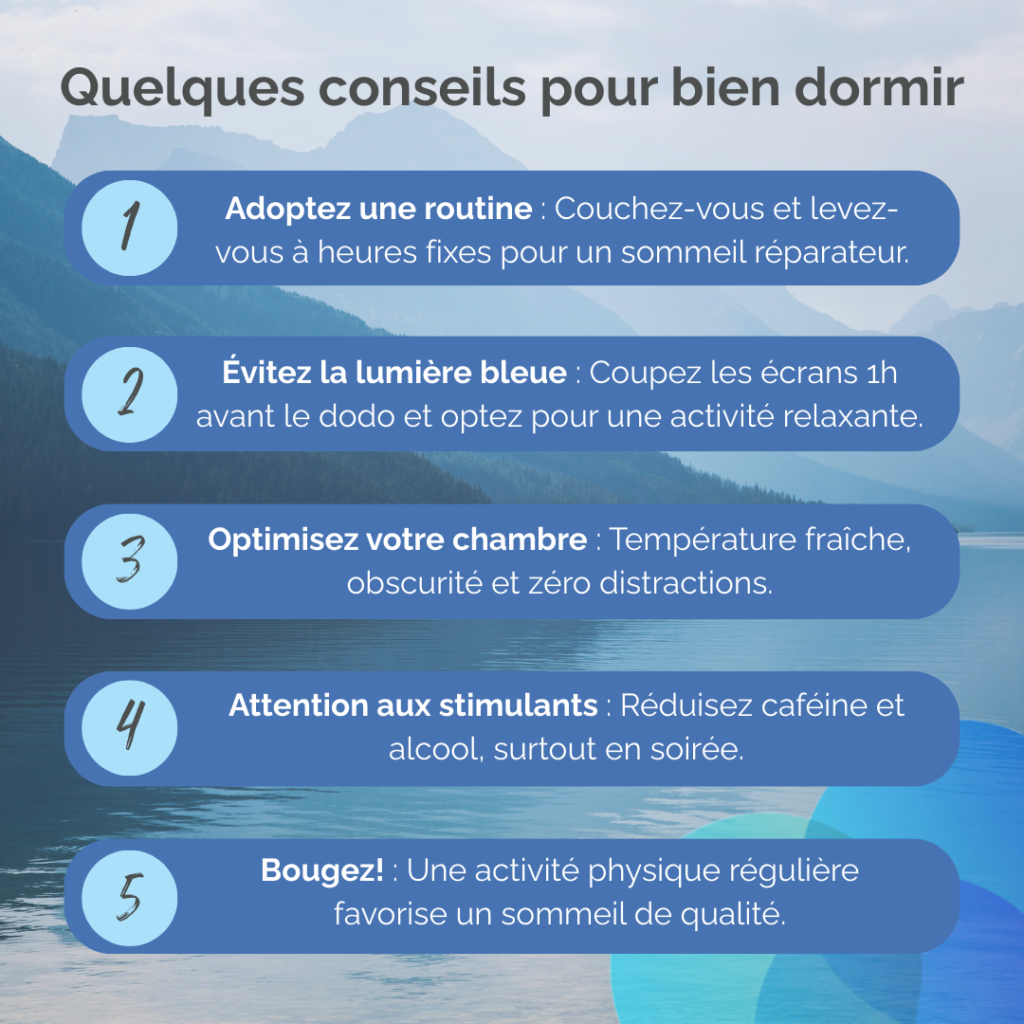
Now that you understand the importance of sleep for your health, you probably want to improve its quality. Here are some tips to establish healthy sleep habits:
Some tips for sleeping well
Treatments available in case of sleep disorders
If you suffer from persistent sleep disorders, you may have a more significant sleep problem. It is then crucial to consult a health professional to assess your physical condition and to rule out any underlying physical problem such as sleep apnea or sleepwalking, which can be evaluated in a sleep clinic. In some cases, medications may also be prescribed. Once any physical cause has been ruled out, it is possible to follow cognitive behavioral therapy with a mental health professional (psychologist, neuropsychologist and other specialists). This type of therapy focuses on good sleep habits and behaviors related to sleep, helping patients improve their routine, better manage their anxiety and stress and correct inappropriate habits.
In conclusion
In short, sleep is a crucial element for maintaining good mental and physical health. Poor-quality sleep can have significant negative repercussions both on our physical health, but also on our mood, emotion regulation and even our concentration. That is why it is essential to take care of the quality of our sleep by adopting good habits and seeking professional help if necessary.
If you suffer from persistent sleep disorders, please do not hesitate to contact us. A member of our team of qualified and experienced mental health professionals can help you better understand the causes of your sleep disorders and will provide you with advice and techniques to improve their quality. Taking care of your sleep is an investment in your overall, physical and mental health. So, don't wait any longer, contact us now to get help and regain restorative sleep.
Sources and resources
Anxiety Canada. (2025). Getting a good night's sleep. https://www.anxietycanada.com/fr/articles/une-bonne-nuit-de-sommeil/
CIUSSS of the Capitale-Nationale. (2025). Act to sleep better. https://www.ciusss-capitalenationale.gouv.qc.ca/services/vivre-sante/sommeil/agir-mieux-dormir
National Institute of Sleep and Vigilance. (n.d.). 10 recommendations from our sleep doctors for sleeping well. https://institut-sommeil-vigilance.org/10-recommandations-de-nos-medecins-du-sommeil-pour-bien-dormir/
Canadian Sleep Society. (2025). https://scs-css.ca/
Statistics Canada. (2024, March 8). There's nothing like World Sleep Day to take a nap. https://www.statcan.gc.ca/o1/fr/plus/5786-rien-de-tel-que-la-journee-mondiale-du-sommeil-pour-faire-une-sieste
Sleep Foundation. (n.d.). Adopt good sleep habits. https://fondationsommeil.com/ameliorer-son-sommeil/adopter-de-bonnes-habitudes-de-sommeil/
L’actualité. (2024, March 15). Nearly one in two Quebecers has sleep problems, a new survey reveals. https://lactualite.com/actualites/pres-dun-quebecois-sur-deux-a-des-problemes-de-sommeil-revele-un-nouveau-sondage/
By
Kym Lefebvre Gamache
Related articles

Preventing mental fatigue: take care of your health to avoid burnout
Between personal responsibilities, the workplace, unexpected events, and an often demanding pace of life, our brains are now under constant strain. Notifications, screens, multitasking, and the need for instant gratification sometimes leave little room to truly unwind or recharge. This reality is becoming increasingly prevalent. In 2023, more than 4.1 million Canadian workers reported experiencing high levels of work-related stress and daily overload.

Understanding grief: stages, emotions and the grieving process | Familio
When pain returns as time passes, it’s normal to wonder why. We hear about the stages of grief, as if simply going through them one by one would make things better. As if there were a "right way" to grieve. Yet grief does not follow a straight line. It can come back in waves, take different forms, and be experienced very differently from one person to another. Understanding what is happening can help put words to what we feel, recognize returning emotions, and know when to seek support.
Caregivers: the often invisible pillars of our society
Supporting a loved one experiencing loss of autonomy, caring for an ill spouse, or being present for a child with particular challenges — for many caregivers, these situations are simply part of daily life. Learn about caregivers, the impact on their mental health, and how to better support them.