


Oppositional Defiant Disorder (ODD) in Children and Adolescents: Understanding and Intervening
What is oppositional defiant disorder?
ODD is a behavioral disorder characterized by a persistent pattern of negative, provocative, and hostile behaviors toward authority figures. This disorder generally affects children and adolescents, but can manifest in rare cases in adults.
Oppositional defiant disorder is distinguished from normal oppositional behaviors by its severity and persistence. There are in fact two phases of normal opposition in human development, between the ages of two and four and between thirteen and fifteen.
What are the symptoms of oppositional defiant disorder?
Children with ODD have behaviors characterized by a persistent, provocative, and hostile negative pattern toward authority figures. This disorder is generally diagnosed in children and adolescents, but can manifest in rare cases in adults.
ODD is distinguished from normal oppositional behaviors by its severity and persistence. This opposition can be characterized by disobedience as well as the following symptoms:
- Difficulty respecting others
- Difficulty managing their own emotions
- Intolerance to frustration
- Refusing to comply with rules and demands of authority
- Arguing persistently and regularly
- Defying authority
- Becomes frustrated easily and is quick-tempered
- Easily annoyed by others
- Having difficulty managing impulsivity
- Being easily irritable and quick-tempered
- Seeking to deliberately provoke others
- Lying and cheating
- Seeking revenge
- Hurting others or breaking things intentionally
- Displaying so-called passive-aggressive oppositional behaviors
It is important to note that not all children who exhibit some of these symptoms necessarily suffer from ODD. A diagnosis by a mental health professional is necessary.
What are the causes of oppositional behaviors?
The underlying causes of ODD are not fully understood, but several factors may play a role:
Oppositional Defiant Disorder (ODD) in Children and Adolescents: Understanding and Intervening
Studies have shown that ODD may have a genetic component.
Environmental factors
The family environment, upbringing, and social interactions can influence the development of ODD.
Neurological factors
- Abnormalities in brain functioning may also be associated with ODD.
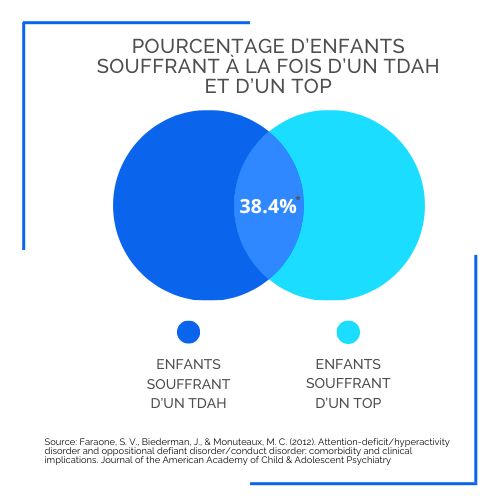
Furthermore, according to a study in the Journal of the American Academy of Child & Adolescent Psychiatry, a little more than one-third of children with attention-deficit/hyperactivity disorder (ADHD) would also have ODD.
When and how is ODD diagnosed?
The diagnosis of oppositional defiant disorder is made by a mental health professional, such as a psychologist or a neuropsychologist. It is often requested by parents or the school when a child exhibits persistent and problematic oppositional behavior. It is based on an interview with the child and their parents, as well as on observation of the child's behavior. According to the Merck Manual, a child can be diagnosed if they have at least four intense and repeated symptoms for at least 6 months.
Treatment for ODD generally relies on cognitive behavioral therapy (CBT). CBT aims to help the child identify their negative thoughts and behaviors and replace them with more positive thoughts and behaviors.
In some cases, a health professional may prescribe medications to help manage ODD symptoms, such as anxiety or anger.
How to intervene in cases of opposition?
If you think your child has ODD, consult a mental health professional for appropriate diagnosis and treatment.
Here are some tips for intervening in cases of opposition:
- Stay calm and patient.
- Set clear and consistent rules.
- Use positive reinforcement.
- Apply predictable negative consequences.
- Communicate positively.
- Encourage listening and problem-solving
- Spend quality time with your child to create a positive bond.
- Consult a mental health professional such as a parenting coach.
What is the impact of oppositional defiant disorder on the child's surroundings and family?
ODD can have a negative impact on the life of the child and their family. Children with ODD may have difficulties at school, making friends, and integrating socially. They may also be at higher risk of developing other disorders, such as depression or conduct disorder.
Resources and support
There are many resources available to help families manage oppositional behaviors. You can find information and support online, from your physician, or from a mental health professional.
A parenting coach can help you to:
- Understand the causes of your child's oppositional behaviors.
- Develop effective intervention strategies.
- Improve communication within the family.
- Strengthen your parenting skills.
If you are struggling with your child's oppositional behaviors, do not hesitate to contact Familio for support and parenting coaching services.
References
Behavioral difficulties: new knowledge, new interventions by the Government of Quebec
Oppositional disorder by Dr. Nadia Gagnier, psychologist in La Presse
What if it were an oppositional disorder? by Julie Champagne in Coup de Pouce
Faraone, S. V., Biederman, J., & Monuteaux, M. C. (2012). Attention-deficit/hyperactivity disorder and oppositional defiant disorder/conduct disorder: comorbidity and clinical implications. Journal of the American Academy of Child & Adolescent Psychiatry
Related articles

Clinical Supervision in Mental Health: Learning, Growing, and Sharing
Clinical supervision can support mental health professionals at various stages of their careers: during training, in the early years of practice, when entering a new field of expertise, or simply when they wish to continue developing their professional practice.

Are you wondering if it's ADHD? When to seek help and what a neuropsychological evaluation is for
Are you wondering if it's ADHD? A neuropsychological evaluation goes beyond a diagnosis and sheds light on how your cognitive functions work in everyday life.
Assessment of dyslexia and dysorthographia: how to recognize them and when to consult
Summer is drawing to a close and already you are thinking about the start of the school year. You recall last year's homework evenings: your child settling down, pencil in hand, trying, trying again. And yet the words get jumbled, reading drags on, writing wears him out. You watch him: a curious, lively child, capable of telling a thousand stories aloud. But when faced with a page, the effort takes over.