


Double exceptionality: when giftedness and disorders meet
Intellectual giftedness is often seen as an undeniable asset: a bright child, eager to learn, who succeeds effortlessly and for whom learning seems a mere formality. We imagine them capable of skipping a grade, accumulating successes and standing out naturally. Yet this vision does not always match reality. Some gifted students do not fit this portrait because their potential can be difficult to recognize when other particularities interfere with its expression.
Long considered a purely academic issue, giftedness can sometimes go unnoticed when it is masked by other behavioral challenges. This phenomenon is known as double exceptionality. It influences identity, self-esteem and life trajectory far beyond school. How can we recognize this reality? What are its impacts in adulthood? This is what we will explore in this article.
Understanding giftedness and double exceptionality
Double exceptionality refers to a situation in which a person has a high intellectual potential (giftedness) and a neurodevelopmental disorder, which can sometimes mask the expression of their potential. These individuals face challenges that complicate their path, both academically and personally. It is essential to remember that giftedness is not a mental disorder: it is not listed in the most recognized classifications of mental disorders, namely the DSM-5 and the ICD-11.
Giftedness and double exceptionality do not necessarily go hand in hand. Some gifted children naturally perform well at school without major difficulty, while others underperform due to lack of stimulation or because certain challenges impede their learning. They may excel in specific areas—sciences, arts, sports—and show insatiable curiosity, fast thinking and marked maturity. Yet their potential can be hard to detect when elements like attention difficulties, hypersensitivity or an atypical learning style blur perceptions.
These children do not always follow classic school expectations. Some refuse to follow an instruction without understanding its purpose, become bored quickly or operate differently from other students. Their quick thinking and way of making connections can lead them to express themselves in an unusual manner, which can be misinterpreted, especially in highly gifted children. In some cases, the symptoms associated with a disorder take over, thereby masking giftedness and making double exceptionality particularly complex to diagnose.
What disorders are generally associated with double exceptionality?
Double-exceptionality profiles are unique and vary depending on the disorder(s) associated with giftedness. Among the most frequently observed are neurodevelopmental disorders such as ADHD, which affects attention, organization and impulsivity, as well as learning disorders like dyslexia, dysorthographia, dyscalculia and dyspraxia. These difficulties can impact reading, writing, mathematics or coordination, thus complicating the school path of doubly exceptional students.
Autism spectrum disorder (ASD) is also often present, leading to particularities in communication, social interactions and sensitivity to stimuli. Other disorders, such as developmental coordination disorder (DCD) or certain language disorders, may also be associated, which sometimes makes identifying giftedness more difficult.
What is the prevalence of double exceptionality?
Double exceptionality is still little known and often difficult to identify, which complicates its estimation. For giftedness, there is no single definition, but certain thresholds are commonly used, as indicated by studies in the scientific literature. The World Health Organization (WHO) sets the threshold for giftedness at an IQ of 130, which represents about 2.2% of the population. The Ordre des psychologues du Québec also notes that this threshold is frequently used to identify intellectual giftedness. This criterion is often assessed using tests like the Wechsler scales, but a professional’s expertise is essential, as each gifted person may present a different profile.
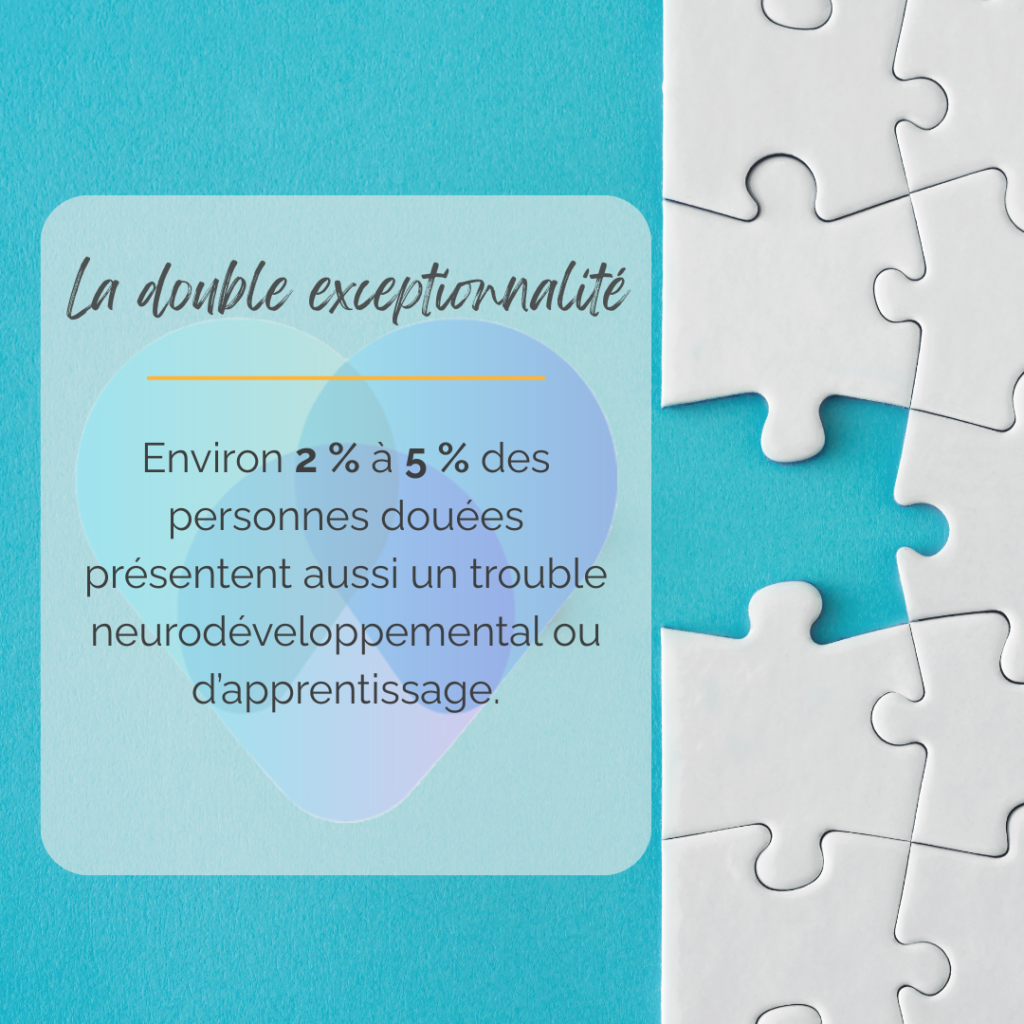
For double exceptionality, it is estimated that about 2% to 5% of gifted individuals also have a neurodevelopmental or learning disorder. However, this estimate remains approximate, because giftedness can mask certain difficulties, and conversely, a disorder can prevent the recognition of high potential. It is this complexity that makes diagnosing and supporting doubly exceptional people more difficult.
When to do a neuropsychological assessment?
There is no precise age to undergo a neuropsychological assessment. Before age five, evaluations focus mainly on behaviors, as IQ tests are less reliable at that age. Some signs, such as great curiosity, fast thinking or a marked interest in complex subjects, can be noticed early, notably in daycare. However, it is often at school entry that gaps between a child’s abilities and their school adaptation become more evident, which may justify an assessment.
A child who is developing well, who is fulfilled and who does not encounter particular difficulties does not necessarily need a diagnosis or an assessment. The purpose of a neuropsychological assessment is not to label, but to better understand a child who experiences challenges or who seems out of sync with their environment. It becomes relevant when the child is bored at school, underperforms despite high potential, or faces adaptation difficulties that hinder their learning and well-being.
In adulthood, many people discover their double exceptionality after the diagnosis of their child. An assessment can be useful if a person feels a persistent mismatch, organizational difficulties or a sense of misunderstanding of their own functioning. Understanding one’s profile makes it possible to adopt appropriate strategies, improve self-esteem and, in some cases, adjust one’s professional or personal environment to better harness one’s potential.
Supporting a doubly exceptional child: what solutions?
Supporting a doubly exceptional child relies on an approach adapted to their strengths and challenges, both at school and at home. A well-supported, fulfilled child who does not present particular difficulties does not necessarily need academic enrichment or a specialized class. However, if the child shows signs of boredom or frustration, pedagogical adaptations can be considered, such as stimulating projects, differentiated instruction or, in some cases, academic acceleration (grade skip or enrichment). The essential thing is to ensure the child can express their full potential while receiving the necessary support to overcome their challenges.
At home, parents play a key role in helping their child better understand their own functioning and develop strategies to overcome their challenges. Listening to their needs without minimizing their emotions, offering a structuring yet flexible framework and valuing their successes are essential elements. The child may sometimes put a lot of pressure on themselves, which is why it is important to encourage them without demanding perfection and to help them manage stress and hypersensitivities.
Collaboration between parents, teachers and professionals (neuropsychologists, special education teachers, psychoeducators) is also crucial. A personalized intervention plan can be put in place at school to ensure the child’s strengths are harnessed while supporting their challenges. By promoting a stimulating and caring environment, we enable the doubly exceptional child to develop their full potential, without their difficulties overshadowing their abilities.
Discovering oneself as doubly exceptional in adulthood: an identity upheaval
Many adults discover their double exceptionality late, often after a child’s diagnosis or while seeking answers to persistent challenges. For years, they may have felt out of sync, not understanding why some things seemed easier than average while others required considerable effort, which is common among people with double exceptionality. This revelation can be a relief, finally putting words to difficult life experiences, but also a shock, challenging deeply held perceptions about oneself.
A journey often marked by misunderstanding
Before the diagnosis, these adults sometimes grew up with labels like "lazy," "dreamer," "too intense" or "unstable." They may have developed coping strategies to hide their difficulties, which allowed them to move forward, but often at the cost of great mental fatigue. Many also experienced excessive self-criticism, reproaching themselves for not being up to par or for having a less linear professional and personal path than others.
Adapting one’s life without turning everything upside down
Unlike children, who may see their environment adapted, an adult cannot change everything overnight. Work, responsibilities, family and social life impose a framework to be managed. The key is therefore not to change everything, but to adjust one’s way of operating to better use strengths and mitigate challenges. This involves concrete strategies: better time organization, choosing an appropriate work environment, learning to manage cognitive fatigue and asking for support when needed.
Finding balance and flourishing
Discovering oneself as doubly exceptional in adulthood does not mean questioning everything, but rather learning to better understand oneself and adapt daily life. An assessment by a professional can help better identify needs related to intellectual giftedness and associated disorders. Specialized support allows exploration of adapted strategies, whether for school, work or emotion management.
Some find a new balance by valuing their skills, adjusting their professional environment or exploring passions outside of work. Others feel the need to be supported during this transition to better manage emotions, cognitive fatigue or the expectations weighing on them. At Familio, our mental health and social services professionals offer tailored support to help each person better understand their functioning and find strategies that suit them. Whether it is to confirm a diagnosis, better manage daily challenges or simply ask questions, making an appointment with a specialist can be a valuable first step toward improved well-being.
Sources
Agence Science-Presse. (2022, October 13). Keeping gifted students in school.
Quebec Association of Neuropsychologists. (2021, May 2). Giftedness and double exceptionality.
Quebec Association for Giftedness. (n.d.). Giftedness and high potential.
Blog Hop’Toys. (2022, February 16). Giftedness: how to approach it?
La Douance. (2025). Giftedness in adults.
Lamolet, B. (2024, August 22). Giftedness: a delay to catch up for Quebec. Québec Science.
Ordre des psychologues du Québec. (2021, June). The assessment of intellectual giftedness.
Vaivre-Douret, L. (2011). Developmental and cognitive characteristics of "high-level potentialities" (highly gifted) children. International Journal of Pediatrics, 2011, Article ID 420297.
Resources to better understand double exceptionality and giftedness
Association québécoise pour la douance. (2022).
Caron, M.-J., & Duval, J. (2021). Giftedness and double exceptionality in the child and adolescent. Éditions Midi Trente. 176 pages.
Centre de services scolaire de Montréal. (2025). Giftedness service.
Integrated Center for the Development of Giftedness and Talent. (n.d.).
Government of Quebec, Ministry of Education. (n.d.). The educational success of gifted students. https://www.education.gouv.qc.ca/fileadmin/site_web/documents/education/adaptation-scolaire-services-comp/Reussite-educative-eleves-doues.pdf
Haut Potentiel Québec. (2023).
Ouellet, R. (2021). Giftedness: Strategies to support high potential in the child. Éditions de Mortagne. 360 pages.
Perrodin, D., Poulin, R., & Revol, O. (2021). 100 ideas + to support high-potential children. Éditions Tom Pousse. 224 pages. Université du Québec à Trois-Rivières. (n.d.). Doubly exceptional students.
By
Kym Lefebvre Gamache
Related articles

The Impact of Remote Work on Mental Health: Warning Signs and Balance
Less morning traffic. No more coffee getting cold in the car. For many people, working from home was initially a relief: more relaxed mornings, time regained, and a schedule better suited to family life. Over time, however, something else can sometimes set in. The workday ends, the computer shuts down, and you’re still in the same place. Interactions have been limited to video calls and quick messages. A subtle form of isolation can then take hold.

Clinical Supervision in Mental Health: Learning, Growing, and Sharing
Clinical supervision can support mental health professionals at various stages of their careers: during training, in the early years of practice, when entering a new field of expertise, or simply when they wish to continue developing their professional practice.

Are you wondering if it's ADHD? When to seek help and what a neuropsychological evaluation is for
Are you wondering if it's ADHD? A neuropsychological evaluation goes beyond a diagnosis and sheds light on how your cognitive functions work in everyday life.