


How to obtain a school waiver
If your child is 4 years old, you probably have an important event in mind that will take place soon: the transition from daycare to elementary school. In this regard, the Education Act provides an age-based eligibility deadline for elementary school: September 30. Some children who will not have reached the required age by that date may, however, show signs of early development.
If this is the case for your child, you may be considering early school entry for them. To apply for it, you will need to obtain a school exemption.
What is a school exemption request?
A school exemption request is an exceptional measure granted to a child to begin elementary school before reaching the required age. It can concern preschool or the first grade.
In Quebec, a child must have reached the age of 5 by September 30 at the latest to be eligible for kindergarten. However, it sometimes happens that, to support a child's development, an early admission request (school exemption) is made. Any exemption request must be supported by a recognized evaluation.
Several scientific studies demonstrate the positive impact of early schooling on children's school trajectories and their overall development. The school exemption is therefore an important tool for the parents and children concerned.
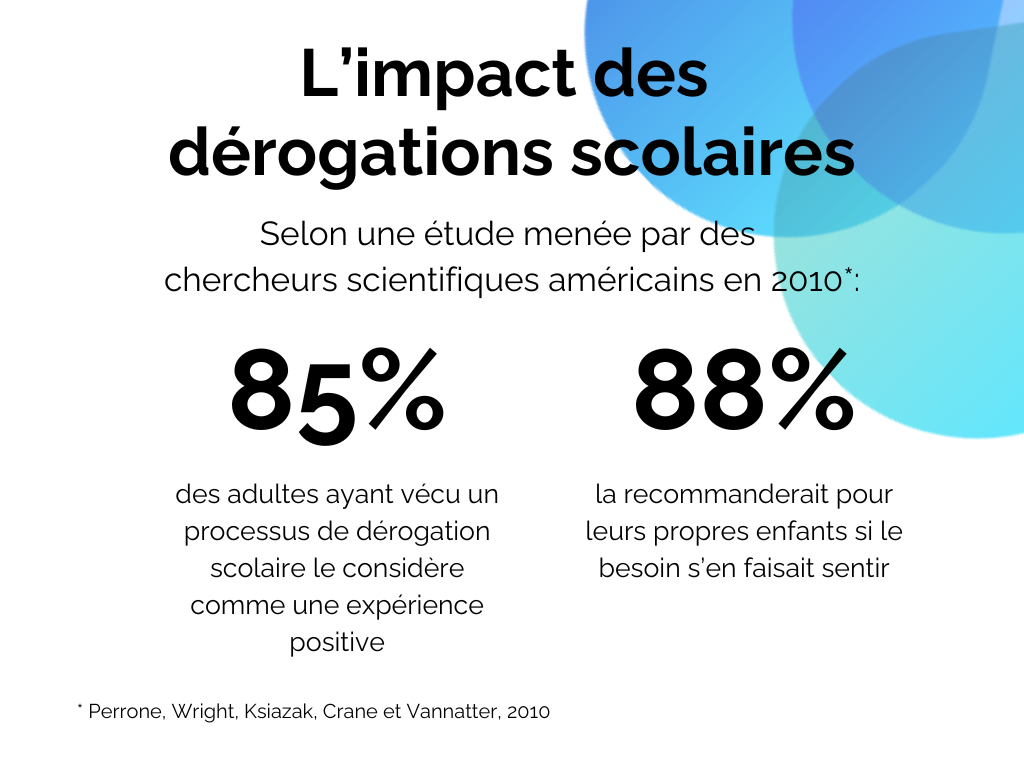
What are the criteria justifying eligibility for an exemption?
An exemption to the age of admission to school is an exceptional measure. It can be granted for humanitarian reasons or to avoid serious harm to the child's development. To be accepted, the child must demonstrate that they stand out significantly in all areas of their development:
– Intellectual
– Linguistic
– Social
– Emotional
– Psychomotor
To this end, an evaluation of the child must be carried out by a qualified psychologist or neuropsychologist who is a member of the 'Order of Psychologists of Quebec (OPQ).
How is the assessment of the level of development carried out and what are the next steps?
Different questionnaires must first be completed by the parents and the child's daycare. Afterwards, the assessment meeting itself takes place in person.
Then, the child attends the meeting with their parents. First there is an interview portion with the parents to learn more about the child's development. Afterwards, the assessment meeting itself begins with the child. It takes place in person, since the activities are in the form of games and the standardized psychometric tests require specific materials.
These tests generally take place over two sessions. After analyzing the results obtained, the professional will pronounce on the child's eligibility or not for the school exemption. If the results objectively demonstrate that the child would benefit from this exceptional measure, the professional writes a letter attesting to this recommendation. It is then given to the parents so they can support their request with their neighbourhood school.
The child's file is forwarded and analyzed by the Service Centre, then the final decision is communicated to the parents and to the administration of the school concerned. In case of refusal, parents have the option of appealing to their School Service Centre.
If you have a 4- or 5-year-old child and think they could benefit from the school exemption, contact us. One of our professionals will help you navigate this process with ease.
Related articles

Clinical Supervision in Mental Health: Learning, Growing, and Sharing
Clinical supervision can support mental health professionals at various stages of their careers: during training, in the early years of practice, when entering a new field of expertise, or simply when they wish to continue developing their professional practice.

Are you wondering if it's ADHD? When to seek help and what a neuropsychological evaluation is for
Are you wondering if it's ADHD? A neuropsychological evaluation goes beyond a diagnosis and sheds light on how your cognitive functions work in everyday life.

Assessment of dyslexia and dysorthographia: how to recognize them and when to consult
Summer is drawing to a close and already you are thinking about the start of the school year. You recall last year's homework evenings: your child settling down, pencil in hand, trying, trying again. And yet the words get jumbled, reading drags on, writing wears him out. You watch him: a curious, lively child, capable of telling a thousand stories aloud. But when faced with a page, the effort takes over.